How Gaming Has Evolved: A Journey Through Time | Zeromagtech
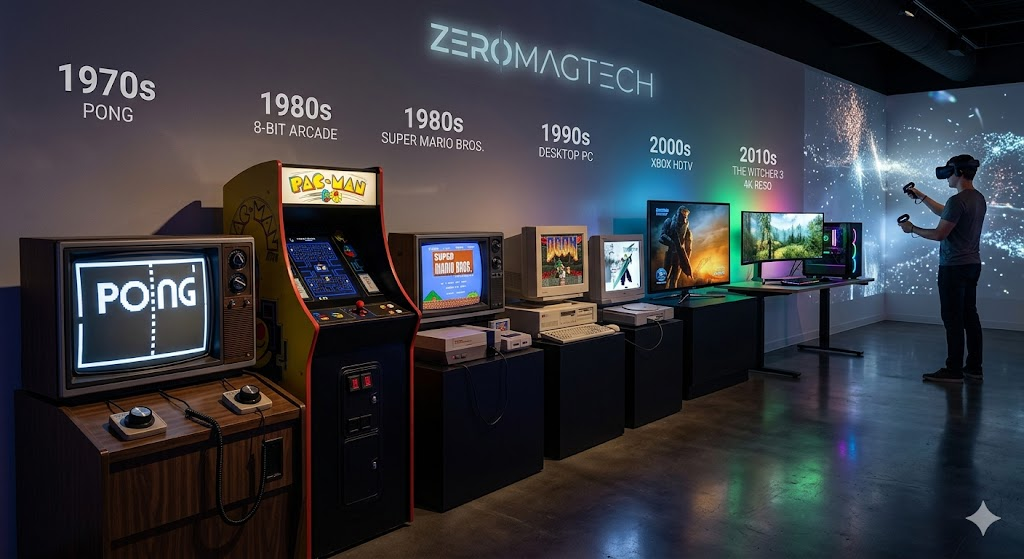
Have you ever wondered how gaming has evolved over the last few decades? It is truly amazing to see the journey from simple blips on a screen to the life-like worlds we explore today. Gaming started as a small science experiment and grew into a massive global hobby. It is not just about fun; it is a story of human creativity and rapid tech growth. Understanding how gaming has evolved helps us appreciate the powerful devices we hold in our hands today. Every new generation of consoles and PCs adds more depth, color, and excitement to our digital adventures.
The Humble Beginnings of Video Games
In the beginning, games were just simple dots moving on old computer screens. Scientists in the 1950s made early versions of tic-tac-toe to test computing power. By the 1970s, the first arcade hits brought gaming into public life. Seeing how gaming has evolved from those tiny blocks to full-color characters is like watching a digital miracle. These early machines had very little memory, but they sparked a revolution that changed entertainment forever. It was the birth of a new era where technology met human imagination in a completely new way.
The Rise of Home Consoles
The 1980s was a special time when gaming moved from the noisy arcade into our living rooms. Home systems allowed us to play for hours without needing a pocket full of coins. As we look at how gaming has evolved, we see that consoles like the Atari and NES were the real game-changers. They brought us iconic heroes and world-famous franchises that we still love today. This shift made gaming a family activity and turned it into a massive part of pop culture for kids and adults alike.
The 16-Bit Era and 3D Graphics
The 1990s brought a huge leap in visual quality with 16-bit systems and the first 3D games. Suddenly, characters looked smooth, and worlds felt much bigger than before. When asking how gaming has evolved, this period stands out as a turning point for artistic design. We moved from flat, 2D sidescrollers into deep, 3D environments that allowed for exploration. This change pushed developers to think bigger and created a foundation for the cinematic storytelling styles that we enjoy in modern titles.
The Explosion of Online Multiplayer
The internet changed everything by letting us play with friends who were miles away. No longer were we stuck playing alone or only with the person sitting next to us on the couch. Learning how gaming has evolved means seeing the birth of global communities and competitive eSports. Online play turned gaming into a social experience that connects millions of people every single day. This was a massive step forward, creating friendships and rivalries that span across entire countries and different cultures.
Gaming Goes Mobile
Smartphones changed the game again by putting a powerful console in almost everyone’s pocket. You no longer need a giant TV or a heavy desktop to enjoy top-tier entertainment. Because of this, how gaming has evolved has included a major focus on accessibility and casual play. Anyone with a phone can now jump into a game during their lunch break or while waiting for the bus. This shift expanded the audience, inviting people who never considered themselves “gamers” into the fold.
The Power of High-Definition Visuals
With the arrival of HD graphics, games began to look like real movies. Detailed textures, realistic lighting, and smooth animations became the new standard for the industry. By observing how gaming has evolved, we can see that developers now focus on creating truly believable worlds. This visual upgrade helped increase the emotional impact of stories, making us care more about characters and their journeys. It turned games into high-end art, pushing the limits of what computers can display on our screens.
The Immersive World of Virtual Reality
Virtual Reality, or VR, is perhaps the most exciting jump in recent years. By wearing a headset, you are no longer just watching a screen; you are inside the game world. When we discuss how gaming has evolved, VR represents the ultimate goal of true immersion and interaction. You can move your hands to touch objects and turn your head to look around naturally. It is a bold step that makes the digital experience feel more tangible than ever before.
Cloud Gaming and Accessibility
Cloud gaming services are now allowing us to stream high-end titles without needing expensive, bulky hardware. This tech is making sure that how gaming has evolved centers on equality and ease of access for all. You can play a massive, beautiful game on a cheap laptop or a tablet using a fast internet connection. This removes the “pay-to-play” barrier, allowing more people to join in on the fun and enjoy the latest releases without spending thousands.
The Role of Artificial Intelligence
Artificial intelligence is now helping developers create smarter, more lifelike enemies and characters. NPCs (non-player characters) can now learn from your actions and change how they react to you. This is a key part of how gaming has evolved, making every single session feel unique and challenging. AI doesn’t just improve gameplay; it helps build dynamic worlds that feel alive. As AI improves, we can expect even more complex stories and personalized challenges tailored just for our specific playstyles.
Looking Toward the Future
The future looks incredibly bright as we continue to push the boundaries of technology. We are seeing faster load times, better physics, and even more detailed environments than ever before. Tracking how gaming has evolved shows us that the sky is truly the limit for what we can build. Whether it is through better social tools or deeper digital realities, gaming will keep changing to keep us entertained. I truly believe we are only just beginning to see what is possible in this space.
Why Gaming Matters Today
Gaming has become a lifestyle and a way to relax after a long day of work. It is also a way for people to learn, solve puzzles, and develop better reflexes. Understanding how gaming has evolved teaches us that gaming is a flexible medium that grows with us. It is more than just a pastime; it is a way to tell stories that movies or books just cannot match. As we move forward, gaming will remain a core part of our digital culture.
Summary Table: Gaming Milestones
| Era | Key Innovation | Impact |
| 1970s | Arcade/First Consoles | Introduced interactive entertainment |
| 1980s | Home Consoles | Gaming became a household activity |
| 1990s | 3D Graphics | Added depth and exploration |
| 2000s | Online Multiplayer | Connected global communities |
| 2010s | Mobile/HD Graphics | Made gaming accessible and cinematic |
| 2020s | VR/Cloud/AI | True immersion and flexibility |
Frequently Asked Questions
1. How has the definition of gaming changed over time?
Gaming used to mean simple research tools, but now it is a massive entertainment medium covering sports, storytelling, and social interaction.
2. Why is technology so important to how gaming has evolved?
Hardware upgrades allow for better graphics, faster processing, and online connectivity, which keep the experience fresh and exciting for players.
3. Will mobile gaming eventually replace consoles?
While mobile gaming is very popular, consoles and PCs still offer a level of power and control that is hard to match for high-end titles.
4. How does AI improve my gaming experience?
AI makes characters smarter and environments more responsive, which makes every game feel like a brand-new, unpredictable challenge for the player.
5. Is cloud gaming worth using?
Yes, it is great if you want to play big games without buying a expensive console, as long as you have a stable internet connection.
6. What is the next big step in the evolution of games?
Most experts agree that fully immersive VR and more advanced AI-driven worlds are the next big frontiers for the industry.
Conclusion
The path of gaming is a fascinating one, filled with constant innovation and endless creativity. We have come a long way, and the future holds even more promise. Whether you are a casual player or a serious pro, there has never been a better time to be a gamer. How gaming has evolved continues to inspire new ideas and new ways to connect. What has been your favorite step in this journey so far? Share your thoughts in the comments below!





Post Comment